Jan's Looms - Multi-shaft Weaving
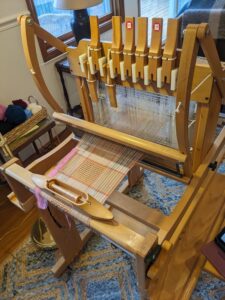
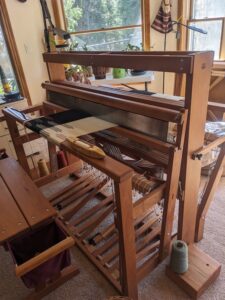
Multi-shaft weaving stimulates Jan’s technical side with its mechanical weaving hardware, complex structures and patterns, and computer software and portable devices that assist both pattern development and the weaving process.
Multi-shaft looms for the hand weaver are usually floor looms or table looms. The floor looms are large, sit on the floor and can accommodate woven textiles that are many yards long. Commonly available floor looms can produce a woven fabric that is as narrow as a tea towel or as wide as a 60 inch bed cover, depending upon the model. Floor looms are often considered to be pieces of furniture weighing up to several hundred pounds.
Table looms, by contrast, are much smaller and are designed to be portable and to be used on a table. Some table looms even fold up for transportation to weaving classes.
A multi-shaft loom starts with a square or rectangular frame at the bottom. Attached to and above the frame, on the front and back are 2 rollers (called beams). At the back, the warp beam holds the warp threads that are ready to be woven. In the front the cloth beam holds the woven fabric. The weaver is positioned outside the loom frame in front of the cloth beam.
Between the warp beam and the cloth beam is the area where the weaving magic happens. Immediately in front of the warp beam are a set of frames (called harnesses or shafts) that hold the heddles vertically in place. (A heddle is usually a narrow strip of metal or plastic with a hole through which the warp thread is placed.) Each warp thread is placed, individually, through a single heddle. The raising or lowering of the shafts raises or lowers warp threads, allowing the weft thread to go under or over the warp. The relative placement of the heddles in the shafts and the order of the shafts are major determinants of the structure and pattern of the woven fabric.
After passing through the heddles, the warp threads are placed through individual slots of a reed. The reed slot spacing is chosen to maintain the proper spacing of the warp threads as the weft is inserted and beaten into the fabric. The reed also serves as the beater to pack the weft.
As the weaving progresses and woven cloth is produced, it is rolled onto the cloth beam. When completed, the cloth is removed from the loom and the ends of the warp threads are secured into a hem, fringe or other decorative feature. After the threads are secured, the entire weaving is “finished” by washing by the technique determined by the weaving structure and the warp and weft thread materials. The “finishing” allows the warp and weft threads to relax and find their final woven position.